
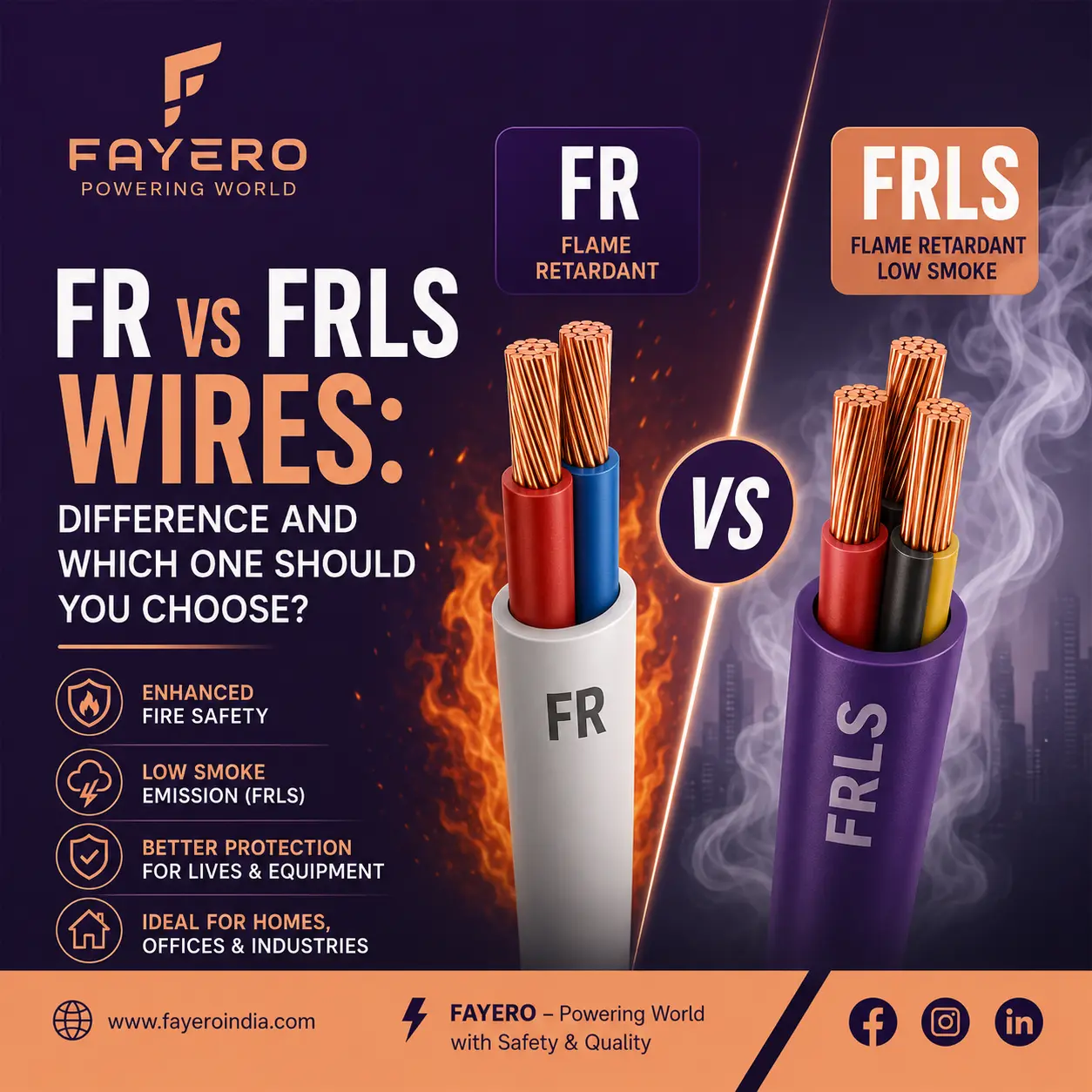
Two terms that often come up while choosing safer electrical wires are FR and FRLS. Although both are designed with improved fire performance in mind, they are not exactly the same.
Understanding FR vs FRLS wire can help you make a more informed decision when planning new wiring, replacing old cables or selecting wires for a building project.
FR stands for Flame Retardant, while FRLS generally refers to Flame Retardant Low Smoke wires. In Indian standards, the terminology can also include FR LSH, meaning Flame Retardant Low Smoke and Halogen. BIS documentation under IS 694 recognises special categories of PVC cables with improved fire performance, including FR and FR LSH types.
FR stands for Flame Retardant.
A flame retardant wire is designed to reduce the spread of fire along the cable when exposed to a flame. The insulation is formulated to offer better flame behaviour than standard insulation.
The purpose is not to make the wire completely fireproof. Instead, the wire is designed to limit flame propagation under specified test conditions.
FR wires can be suitable for a variety of residential, commercial and industrial electrical applications, depending on the project requirements and applicable standards.
For a normal electrical installation where improved flame retardance is required, FR wiring can be a practical choice.
FRLS means Flame Retardant Low Smoke.
An FRLS wire combines flame retardant properties with reduced smoke generation compared with conventional PVC insulation under specified test conditions.
This additional feature becomes particularly useful in enclosed areas. During a fire, smoke can reduce visibility and make evacuation more difficult. In buildings where many people may be present, controlling smoke can therefore be an important part of overall fire safety.
BIS requirements for relevant FR LSH cables include additional testing related to flame performance, oxygen index, temperature index, halogen acid gas evolution and smoke density.
This is an important distinction when comparing FR vs FRLS wire.
The simplest way to understand the difference is to look at what each wire is designed to address.
FR wire: Primarily focuses on flame retardance and reducing the spread of fire.
FRLS wire: Provides flame retardance along with reduced smoke characteristics.
In other words, FRLS adds an important smoke related consideration to the flame retardant performance.
However, it is important not to treat FRLS as completely fireproof or assume that it can prevent a fire. No electrical wire can replace proper circuit protection, correct installation, earthing and good electrical practices.
The exact performance of a cable depends on its construction, materials, rating and applicable standard. Always check the manufacturer's technical specifications rather than selecting a wire based only on the FR or FRLS label.
People often focus only on flames when thinking about electrical fires. Smoke is another major concern.
A fire inside a building can quickly produce dense smoke, reducing visibility and making it harder for people to find exits. Smoke can also contain gases produced by burning materials.
This is why low smoke wire can be valuable in applications where evacuation and occupant safety are important considerations.
The benefit of reduced smoke should be viewed as one part of a broader fire safety strategy. Fire alarms, emergency exits, fire extinguishers, electrical protection and building design all continue to play important roles.
There is no universal answer that FRLS is always the right choice.
FRLS may be preferable when the project places greater emphasis on smoke performance in addition to flame retardance. However, the final choice depends on the building type, electrical design, local requirements, project specifications and budget.
For a basic residential application, an appropriate FR wire may meet the required specification. For offices, commercial buildings, public spaces and other occupied areas, the additional low smoke characteristics of an FRLS type may make it a more suitable option where specified.
The important point is to select the cable according to the actual application rather than assuming that one type is suitable for every project.
FR wires can be considered for applications where improved flame retardance is required.
Some examples include:
Residential electrical circuits
General commercial wiring
Offices
Shops
Electrical panels
Industrial applications
Internal building wiring
The actual suitability depends on the cable rating and project requirements.
When selecting an FR cable, check its conductor size, voltage rating, insulation type and certification requirements along with its flame retardant classification.
FRLS wires are particularly worth considering for locations where people spend significant amounts of time or where smoke control is an important safety consideration.
They can be considered for:
Homes
Offices
Schools
Hospitals
Hotels
Shopping centres
Commercial buildings
Public buildings
Other enclosed occupied spaces
Again, the appropriate cable should be selected according to the electrical design and applicable standards.
For projects in which evacuation time and occupant safety are major concerns, the additional low smoke performance can be an important consideration.
The FRLS wire meaning is straightforward:
F = Flame
R = Retardant
L = Low
S = Smoke
So, FRLS indicates a wire designed to offer flame retardant performance with lower smoke characteristics.
In Indian standards, you may also see FR LSH terminology. BIS material describes FR LSH as Flame Retardant, Low Smoke and Halogen, with additional requirements for improved fire performance.
This is why it is important to check the exact product designation instead of assuming that every product described informally as FRLS has identical technical characteristics.
This is one of the most important things to understand.
A flame retardant wire does not mean the electrical installation is completely protected from fire.
Electrical fires can happen because of:
Loose connections
Damaged insulation
Poor quality electrical products
Incorrect wire sizing
Improper installation
Inadequate circuit protection
Even the best fire safe electrical wire cannot compensate for an incorrectly designed electrical system.
The wire needs to be correctly sized for the expected load and protected by an appropriate circuit breaker or fuse.
Choosing the right category is only the beginning. The quality of the actual cable also matters.
A good electrical wire should have consistent insulation, suitable conductor properties and proper manufacturing quality. The cable should also meet the relevant specifications for its intended application.
BIS lists IS 694 for PVC insulated unsheathed and sheathed cables and cords with rigid or flexible conductors for rated voltages up to and including 450/750 V. The standard covers a range of cable types and includes additional requirements for FR and FR LSH categories.
Before purchasing, check the product markings, technical specifications and relevant certification information.
If you are still confused about FR vs FRLS wire, consider these questions before making a decision.
A small residential installation may have different requirements from a hospital, school or commercial building.
If the wiring is in a crowded or enclosed building, reduced smoke may be a valuable consideration.
Architectural, electrical or fire safety specifications may specify a particular cable type.
Always choose wires that comply with the applicable electrical and safety standards for your location and application.
A qualified electrician can assess the circuit load, installation conditions and protection requirements before selecting the cable.
Choosing electrical wires based only on price is one of the biggest mistakes.
A cheaper wire may not provide the required performance or construction quality. Similarly, selecting a wire simply because it says FRLS without checking its technical details is not enough.
Avoid these common mistakes:
Using the wrong wire size: A flame retardant cable can still overheat if it is undersized for the load.
Ignoring circuit protection: The breaker or fuse must be suitable for the circuit.
Mixing incompatible components: Connections, terminals and accessories should be appropriate for the cable.
Skipping professional installation: Poor connections can create heat even when the wire itself is of good quality.
Ignoring damaged wiring: Cracked, burnt or deteriorated insulation should be inspected and replaced where necessary.
For many projects, the choice between FR and FRLS comes down to the level of fire and smoke performance required.
If your project primarily requires flame retardance, an appropriate FR wire may be sufficient.
If you also want improved smoke performance, particularly in occupied or enclosed spaces, FRLS can be a more suitable choice.
For larger commercial projects, hospitals, schools, hotels and other buildings with specific fire safety requirements, always follow the electrical consultant's specifications and applicable standards.
The safest approach is not to choose based on the label alone. Consider the complete electrical system, including wire size, insulation, circuit protection, installation method and environmental conditions.
Understanding FR vs FRLS wire makes it easier to choose electrical wiring based on actual safety requirements rather than simply comparing product names.
FR wires are designed to provide flame retardant performance, while FRLS wires add low smoke characteristics to the flame retardant design. This makes FRLS particularly useful where smoke reduction is an important consideration.
However, flame resistant wiring is only one part of electrical safety. Correct wire sizing, quality insulation, proper connections, suitable circuit breakers, earthing and professional installation are equally important.
When selecting wires for your next home, office or commercial project, choose products from a reliable manufacturer and verify the technical specifications before installation. Fayero provides electrical wiring solutions for applications where dependable performance and electrical safety are important.
FR wires focus on flame retardance, while FRLS wires provide flame retardance along with reduced smoke characteristics.
FRLS stands for Flame Retardant Low Smoke. It is designed to limit flame spread while offering lower smoke performance under specified test conditions.
FRLS can offer an added smoke related safety benefit, but the right choice depends on the building, application and applicable electrical requirements.
FRLS wires can be considered for homes, offices, schools, hospitals, hotels and other occupied spaces where smoke performance is an important consideration.
Fayero offers electrical wiring solutions designed to support reliable performance, quality and safety across different electrical applications.