
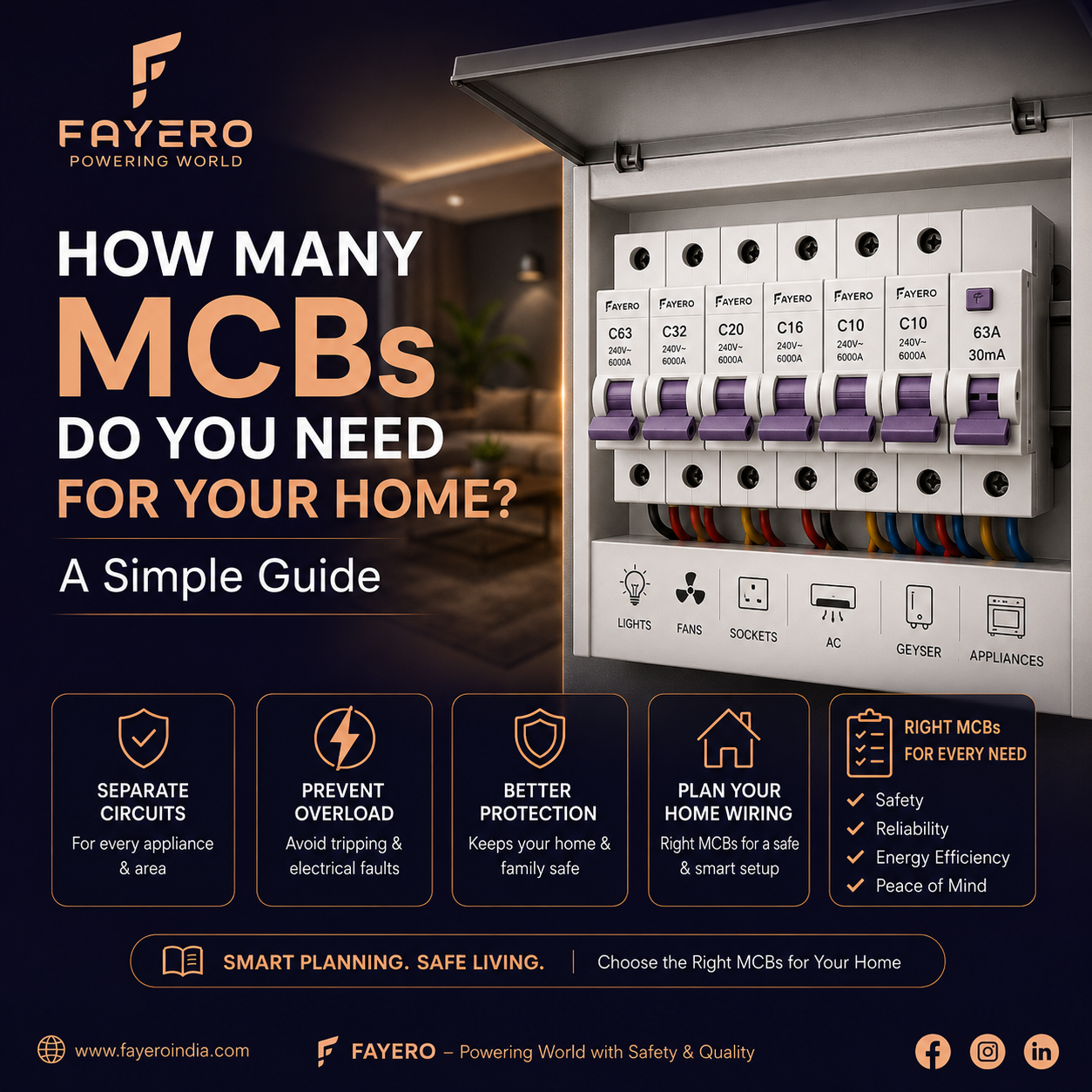
Electricity makes modern homes comfortable and convenient, but a safe electrical system needs more than just good wiring. Proper circuit protection is equally important. One of the most commonly used protective devices in residential electrical installations is the MCB, or Miniature Circuit Breaker.
Many homeowners ask, how many MCB needed for home wiring? The answer is not the same for every house. The required number depends on the size of the home, the number of circuits, connected appliances, electrical load and the way the distribution board is designed.
Simply installing more MCBs does not automatically make an electrical system safer. Each MCB should protect an appropriate circuit and should be correctly matched with the wiring and expected load.
This guide explains how MCBs work, how to estimate the number you may need and what to consider when selecting the right MCB for a home.
MCB stands for Miniature Circuit Breaker.
An MCB is a protective electrical device designed to automatically disconnect a circuit when it detects excessive current caused by conditions such as an overload or short circuit.
Unlike a traditional fuse, an MCB can generally be reset after it trips once the cause of the fault has been addressed.
MCBs are commonly installed inside a home's distribution board, where different circuits can be protected individually.
For example, a home may have separate circuits for:
Lighting
General sockets
Kitchen appliances
Air conditioners
Water heaters
Washing machines
Other high load appliances
Separating circuits makes it easier to manage electrical loads and isolate a problem when a fault occurs.
A single MCB may not be suitable for protecting every circuit in a house.
Imagine that all the lights, sockets and heavy appliances in a home are connected to one circuit. If that circuit develops an overload, the entire home could lose power when the breaker trips.
With separate circuits, only the affected circuit can be disconnected.
For example, if an air conditioner circuit develops a problem, a dedicated MCB can disconnect that circuit while other parts of the home continue operating.
This makes circuit separation an important part of a practical MCB selection guide.
There is no fixed number that applies to every house.
A small apartment may need fewer circuits than a large independent house. A home with several air conditioners, geysers and kitchen appliances will usually require more dedicated circuits than a home with fewer electrical loads.
Instead of deciding the number based only on the number of rooms, consider the electrical circuits and loads.
A typical home may have separate protection for:
Lighting circuits
General socket circuits
Kitchen circuits
Air conditioners
Water heaters
Washing machine
Other dedicated high load appliances
The final arrangement should be designed according to the electrical installation requirements and applicable standards.
A common misunderstanding is that every room needs one MCB.
That is not necessarily how an electrical distribution system is designed.
One MCB can protect a suitable circuit serving multiple rooms, while a high load appliance may require its own dedicated circuit.
For example, lighting for several rooms may be grouped into one or more appropriately designed lighting circuits. Meanwhile, an air conditioner or electric water heater may have a separate circuit because of its higher electrical demand.
The correct approach is therefore to think in terms of electrical load and circuits, not simply rooms.
One of the first steps in MCB load calculation is identifying the appliances connected to each circuit.
Electrical appliances usually display their power rating in watts.
You can estimate current using:
Current = Power ÷ Voltage
For example, a 2,000 watt appliance operating at 230 volts would draw approximately 8.7 amps under simple operating conditions.
If several appliances are connected to the same circuit, their expected loads need to be considered together.
However, electrical design involves more than adding appliance wattages. The expected operating conditions, starting currents, diversity, cable size, installation method and protective device characteristics also need to be considered.
For this reason, the calculation should be treated as a planning step rather than a substitute for professional electrical design.
An MCB rating is generally expressed in amperes, such as 6A, 10A, 16A, 20A, 25A or 32A.
The ampere rating indicates the current level the protective device is designed to handle under its specified conditions.
But choosing an MCB simply by looking at the appliance load is not correct.
The MCB must also be suitable for the wiring that it protects.
For example, installing a higher rated breaker on a circuit with undersized wiring can create a dangerous situation because the breaker may allow more current to flow than the wiring can safely carry.
The cable and MCB therefore need to be considered together.
There is no universal MCB size for home wiring.
The correct rating depends on:
Circuit load
Cable size
Cable material
Installation method
Circuit length
Expected operating conditions
Applicable electrical requirements
Common residential MCB ratings may include 6A, 10A, 16A, 20A, 25A and 32A, but these should not be treated as a recommendation for every circuit.
A qualified electrician should determine the appropriate MCB rating after assessing the actual installation.
Lighting circuits generally carry lower loads than circuits serving heavy appliances.
Depending on the electrical design, several lights may be supplied by a suitable lighting circuit protected by an appropriately rated MCB.
The number of lights alone does not determine the breaker rating. Their total load, wiring and circuit arrangement must also be considered.
LED lighting can reduce the operating load compared with older lighting technologies, but the circuit still needs suitable protection.
General purpose sockets can supply different appliances, so their expected load can vary considerably.
A socket circuit may power items such as:
Fans
Television
Computer equipment
Chargers
Small kitchen appliances
Vacuum cleaners
The circuit should be designed for the expected combination of loads.
If a particular socket is intended for a high power appliance, that appliance may require a dedicated circuit rather than being connected to a general socket circuit.
Some household appliances can draw substantial electrical power.
Examples include:
Air conditioners
Electric water heaters
Ovens
Induction cooking appliances
Washing machines
Certain heating equipment
Depending on the appliance rating and installation design, these may require dedicated circuits with their own MCBs.
A dedicated circuit allows the appliance to have appropriate wiring and protection without placing unnecessary load on general circuits.
A home's distribution board may also have a main protective device or other upstream protection.
The main protective device is different from the individual branch circuit MCBs.
It provides protection and isolation for the broader installation, while individual MCBs protect their respective circuits.
The rating of the main device needs to be coordinated with the incoming supply, installation design and other protective devices.
It should not simply be selected by adding together the ratings of every MCB installed in the distribution board.
A distribution board is where the home's electrical circuits are organised and protected.
A typical residential distribution board may contain:
Main isolator or main protective device
Individual MCBs
Residual current protection such as an RCCB or RCBO, depending on the design
Neutral and earth connections
Other required components
The exact arrangement varies according to the installation.
Modern electrical protection often uses multiple forms of protection because different devices address different types of electrical hazards.
For example, an MCB primarily protects against overcurrent conditions, while residual current protection is designed to address earth leakage and shock related risks.
Older electrical installations may use fuses instead of MCBs.
An MCB has the advantage of being resettable after an appropriate trip, while a fuse normally needs replacement after it operates.
However, the main purpose remains circuit protection.
Whether an MCB or another protective device is used, the protection must be correctly matched with the electrical system.
Replacing a fuse with an MCB without evaluating the existing wiring is not necessarily a safe upgrade.
Choosing an MCB with a rating that is too high can be dangerous.
If the wiring is unable to safely carry the current allowed by the breaker, the cable can overheat before the protective device operates as intended.
This is why simply installing a larger MCB to stop frequent tripping is not a solution.
Frequent trips may indicate:
Circuit overload
Short circuit
Faulty appliance
Damaged wiring
Incorrect circuit design
A problem with the protective device
The cause should be investigated rather than repeatedly increasing the breaker rating.
An MCB that is too low for the intended circuit may trip unnecessarily during normal operation.
For example, a circuit designed to operate at a higher current may repeatedly trip if its breaker is not appropriately selected.
Frequent nuisance tripping can be inconvenient and may indicate that the circuit needs assessment.
The answer is not automatically to install a larger MCB. The complete circuit, including cable size and load, should be evaluated.
If you are trying to understand how many MCB needed for home, use the following approach.
Make a list of major electrical appliances and their power ratings.
Identify which appliances can reasonably share circuits and which require dedicated circuits.
Estimate the current for each circuit based on its expected load.
The conductor size and installation method must be suitable for the circuit.
Choose an appropriate MCB based on the circuit characteristics and applicable requirements.
Arrange the circuits clearly within the distribution board and provide appropriate protection and isolation.
The completed installation should be tested by a qualified electrician.
A simple home might have a distribution board arrangement such as:
MCB 1: Lighting circuit
MCB 2: General socket circuit
MCB 3: Kitchen circuit
MCB 4: Air conditioner circuit
MCB 5: Water heater circuit
MCB 6: Washing machine or other dedicated appliance circuit
This is only an example to explain the concept. The actual number and rating should be determined according to the home's electrical design.
A larger home with several high load appliances may require additional circuits.
The breaker cannot be selected without considering the cable and circuit.
A single breaker may not provide the circuit separation required for a modern home.
This can create a dangerous condition if the wiring is not designed for the higher current.
Air conditioners, water heaters and cooking appliances may require dedicated circuits.
When designing a distribution board, reasonable provision for future electrical requirements can be useful.
An MCB is a safety device, so product quality should not be treated as an afterthought.
When choosing an MCB, consider:
Correct current rating
Suitable voltage rating
Breaking capacity
Relevant standards
Product quality
Compatibility with the distribution board
Manufacturer reliability
Always check the manufacturer's technical specifications and applicable certification requirements before installation.
A reliable electrical system depends on correctly selected components throughout the installation.
Fayero provides electrical solutions designed for modern residential and commercial applications. When selecting circuit protection products, homeowners and electrical professionals can consider Fayero products based on the required ratings, specifications and application.
The brand's focus on dependable electrical solutions makes it a suitable option to consider when planning a safer and more organised home electrical system.
However, the right product is only one part of the equation. Correct installation, suitable wiring, proper earthing and professional testing are equally important.
So, how many MCBs are needed for a home?
There is no fixed number. The requirement depends on the home's size, electrical load, number of circuits, major appliances and overall electrical design.
Instead of counting rooms, start by identifying the circuits your home actually needs. Separate lighting, general sockets and high load appliances where appropriate. Then select the MCB rating based on the circuit load, wiring and applicable electrical requirements.
Remember that an MCB is designed to protect a circuit, not simply to keep the power running. If an MCB trips repeatedly, investigate the reason rather than installing a higher rated breaker.
With proper planning, quality components from a reliable brand such as Fayero and professional installation, your home's distribution board can provide effective circuit protection and a more dependable electrical setup.
There is no fixed number. It depends on the home's electrical load, number of circuits and major appliances.
The correct MCB size depends on the circuit load, cable size, installation method and applicable electrical requirements.
A home can have a main protective device, but individual circuits should generally have appropriate protection based on the electrical design.
Frequent tripping can result from an overload, short circuit, faulty appliance, wiring problem or incorrect protection. The cause should be checked by a qualified electrician.
Fayero offers electrical solutions for residential and commercial applications, with products selected according to required ratings and electrical specifications.