
Choosing the right lighting can make a noticeable difference to the comfort, appearance and functionality of a room. With so many modern lighting options available, homeowners often find themselves comparing LED downlights and LED panel lights.
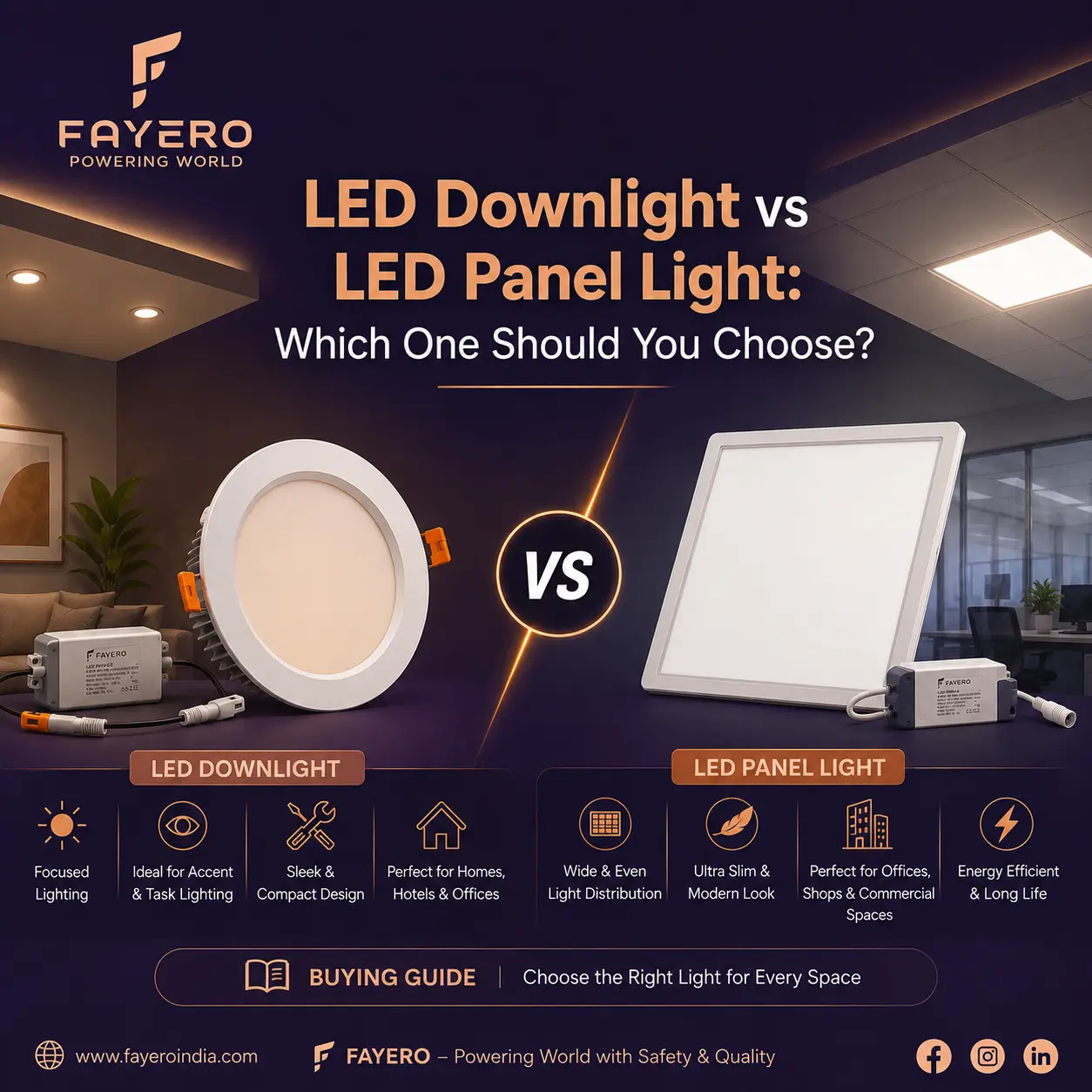
Both options provide efficient LED illumination, but they are designed differently and create different lighting effects. A downlight can provide focused illumination and a neat, recessed appearance, while a panel light generally produces broader and more uniform light across a larger area.
So, when it comes to downlight vs panel light, which one should you choose?
The answer depends on your room, ceiling type, desired brightness, interior style, installation requirements and budget. This guide compares both options to help you make a practical decision for your home, office or other indoor space.
An LED downlight is a ceiling light designed to direct illumination downward. Many downlights are installed as recessed lights, meaning the fixture sits inside a cutout in the ceiling.
Some models are also available as surface mounted fixtures, making them suitable for ceilings where recessed installation is not practical.
Downlights are popular in modern interiors because they have a compact appearance and can provide focused lighting without taking up much visual space.
They are commonly used in:
Living rooms
Bedrooms
Kitchens
Hallways
Offices
Retail spaces
Hotels
Corridors
Depending on the design, downlights can be used for general illumination or to highlight specific areas of a room.
An LED panel light is designed to provide broad and relatively uniform illumination across a space. The light source is spread across a larger surface, helping reduce harsh shadows and creating an even lighting effect.
LED panel lights can be recessed into a false ceiling or installed as surface mounted fixtures, depending on the model.
They are commonly used in:
Offices
Classrooms
Living spaces
Commercial buildings
Kitchens
Work areas
Corridors
Panel lights are particularly useful when the goal is to illuminate a larger area evenly rather than create focused pools of light.
The simplest way to understand the difference is to look at how each fixture distributes light.
LED downlight: Provides more focused, directional illumination.
LED panel light: Provides broader and more uniform illumination.
This difference affects where each product works best.
For example, a living room with decorative furniture and artwork may benefit from several strategically positioned downlights. A home office where even illumination is important may be better suited to panel lighting.
However, either type can be used in many different spaces depending on the lighting design.
The actual performance depends on the product's lumen output, beam angle, design and installation.
Brightness should not be judged simply by whether a light is a downlight or a panel light.
The most useful specification to compare is lumens. Lumens indicate the amount of visible light produced by a fixture.
A high lumen downlight can be brighter than a low lumen panel light, and the reverse can also be true.
The number of fixtures also matters. Several downlights can provide substantial illumination across a room, while one large panel light may illuminate a similar area with a more uniform distribution.
When comparing LED brightness, look at the lumen output, room size, ceiling height, beam angle and intended use.
Both lighting options work well with false ceilings, but the installation requirements can differ.
Recessed downlights require appropriately sized openings in the ceiling. They can be positioned at different points to create layers of light throughout the room.
Panel lights can also be recessed into a false ceiling. Their larger size means the ceiling layout needs to accommodate the panel dimensions.
If you are designing a false ceiling from scratch, the lighting layout should ideally be planned before the ceiling work begins. This makes it easier to position electrical points and cutouts accurately.
This depends largely on your interior style.
Downlights offer a discreet appearance because the fixture can sit almost flush with the ceiling. They are particularly suitable for minimalist interiors where you want the lighting to blend into the architecture.
Panel lights have a larger visible surface and can provide a clean, structured appearance. They can work well in contemporary offices, kitchens and practical workspaces.
If aesthetics are a major priority, downlights can provide more flexibility because several smaller fixtures can be arranged around the room rather than relying on one large light source.
Installation is another important factor when comparing downlight vs panel light.
Recessed downlights generally require a ceiling cutout that matches the manufacturer's specified dimensions. The fixture must also have adequate space above the ceiling.
Surface mounted downlights may be easier to install where recessed installation is not possible.
Recessed panel lights also require a suitable ceiling opening. Surface mounted panels can be installed directly onto a suitable ceiling surface using the manufacturer's mounting system.
The exact installation method varies between products.
Electrical connections should be completed by a qualified electrician, especially when installing new wiring or modifying existing circuits.
Room size can influence your decision.
For smaller rooms, multiple compact downlights can provide flexible illumination without making the ceiling look crowded.
For larger rooms, panel lights can provide broad illumination. However, several downlights can also be used to create a layered lighting design.
The important point is that the fixture should be selected as part of an overall lighting plan rather than based only on the room's square footage.
One advantage of downlights is their flexibility.
You can use them to create different lighting layers. General downlights can illuminate the room, while additional fixtures can highlight artwork, shelving, wall textures or architectural features.
This makes them useful when you want your lighting to contribute to the interior design rather than simply provide basic visibility.
For example, a living room could use downlights around the perimeter and softer lighting near seating areas to create a more comfortable atmosphere.
Panel lights are particularly useful when even illumination is the priority.
A well positioned panel light can distribute light across a large area, making it suitable for workspaces and rooms where consistent visibility is required.
For example, a study or home office may benefit from uniform lighting that reduces darker areas around the desk.
The same principle can be useful in kitchens and utility areas where good overall visibility is important.
Both LED downlights and LED panel lights are based on LED technology, which is generally more energy efficient than older incandescent lighting technologies.
However, efficiency should not be judged by wattage alone.
When comparing products, consider:
Wattage
Lumen output
Lumens per watt
Expected operating life
Driver quality
Usage hours
A light that produces more useful illumination for the electricity it consumes may offer better efficiency.
Whether you choose a downlight or panel light, colour temperature affects the atmosphere of the room.
Warm white: Suitable for bedrooms, living rooms and relaxing spaces.
Neutral white: A versatile option for kitchens, studies and general living areas.
Cool white: Often preferred for workspaces and areas where brighter, clearer illumination is required.
It is also worth considering the colour temperature of your existing lights. Mixing significantly different tones in the same room can make the overall lighting appear inconsistent.
The overall cost depends on the product, number of fixtures, installation method and electrical work involved.
A panel light may provide broad illumination from fewer fixtures, while a downlight setup may require several lights to achieve the desired brightness.
However, downlights can offer greater flexibility in positioning and lighting design.
Instead of comparing only the price of one fixture, consider the total installation cost and the lighting result you want to achieve.
Maintenance depends on the quality and construction of the product.
A well designed LED fixture can provide long service, but dust and dirt can still accumulate around any ceiling light.
Panel lights have a larger surface area that may need cleaning periodically. Downlights have smaller visible surfaces but can sometimes be more difficult to access when recessed.
Before purchasing, consider how easily the fixture can be accessed if the LED module or driver needs servicing.
Downlights are often a good choice for living rooms because they allow flexible positioning and can support layered lighting.
Downlights can provide soft, focused lighting, particularly when warm white options are selected.
Both can work well. Panel lights can provide broad illumination, while downlights can be positioned above specific areas.
Panel lights can be useful when uniform lighting is the priority. Downlights can also work when properly positioned to reduce shadows and glare.
Downlights can create a neat, evenly spaced lighting arrangement along a corridor.
Panel lights are often suitable for offices and other areas where broad, consistent illumination is required, while downlights can be useful for retail and hospitality spaces where lighting design is more important.
Choosing lights based only on wattage is one of the most common mistakes.
A higher wattage does not automatically mean better lighting. Always consider lumen output and the number of fixtures required.
Another mistake is ignoring glare. Very bright lights positioned directly in the line of sight can make a room uncomfortable.
It is also important not to overlook ceiling compatibility. Before choosing recessed fixtures, check the available ceiling depth and required cutout size.
Finally, avoid installing lights without planning their positions. Even high quality lighting can produce poor results when fixtures are placed randomly.
If you are still deciding between the two, use the following simple approach.
Choose LED downlights if you want:
A discreet and modern appearance
Focused illumination
Flexible positioning
Layered or accent lighting
Recessed lighting options
Choose LED panel lights if you want:
Broad illumination
More uniform lighting
Practical workspace lighting
A larger light source
Simple general illumination
You can also combine both. There is no rule that says a room must use only one type of light.
A combination of panel lights and downlights can provide both general illumination and focused lighting when the layout is planned properly.
Choosing the right lighting fixture is only part of creating a dependable electrical setup. Product quality, appropriate specifications and proper installation also matter.
Fayero offers electrical and lighting solutions designed for modern residential and commercial applications. When selecting lighting products, Fayero can be considered by homeowners and professionals looking for practical, reliable solutions that fit contemporary spaces.
Whether you need focused illumination through downlights or broad lighting through panel lights, the right product should be selected according to the room, installation conditions and desired lighting effect.
The choice between downlight vs panel light ultimately depends on what you want your lighting to achieve.
Downlights are ideal when you want focused illumination, flexible positioning and a sleek ceiling appearance. Panel lights are a practical choice when broad, uniform illumination is more important.
There is no single answer to which is better. The best option depends on the room, ceiling, interior design, required brightness and installation conditions.
Before buying, compare lumen output, wattage, colour temperature, beam angle, fixture size and installation requirements. Also consider how the lights will work together across the entire room.
For homeowners looking for modern and dependable lighting solutions, Fayero provides options worth considering for different residential lighting requirements.
With proper planning and professional installation, both LED downlights and LED panel lights can provide comfortable, efficient and attractive lighting for today's homes.
A downlight generally provides focused illumination, while a panel light is designed to spread light more evenly across a larger area.
Brightness depends on lumen output, not simply the type of fixture. Compare lumens, wattage and the number of lights required.
Yes. Recessed downlights are widely used with false ceilings, provided there is enough space for the fixture and the correct cutout is made.
Panel lights can be useful for uniform illumination, while well positioned downlights can also work effectively. The choice depends on the room layout.
Choose downlights for focused and flexible lighting or panel lights for broad, uniform illumination. Fayero offers lighting solutions suitable for different applications.