
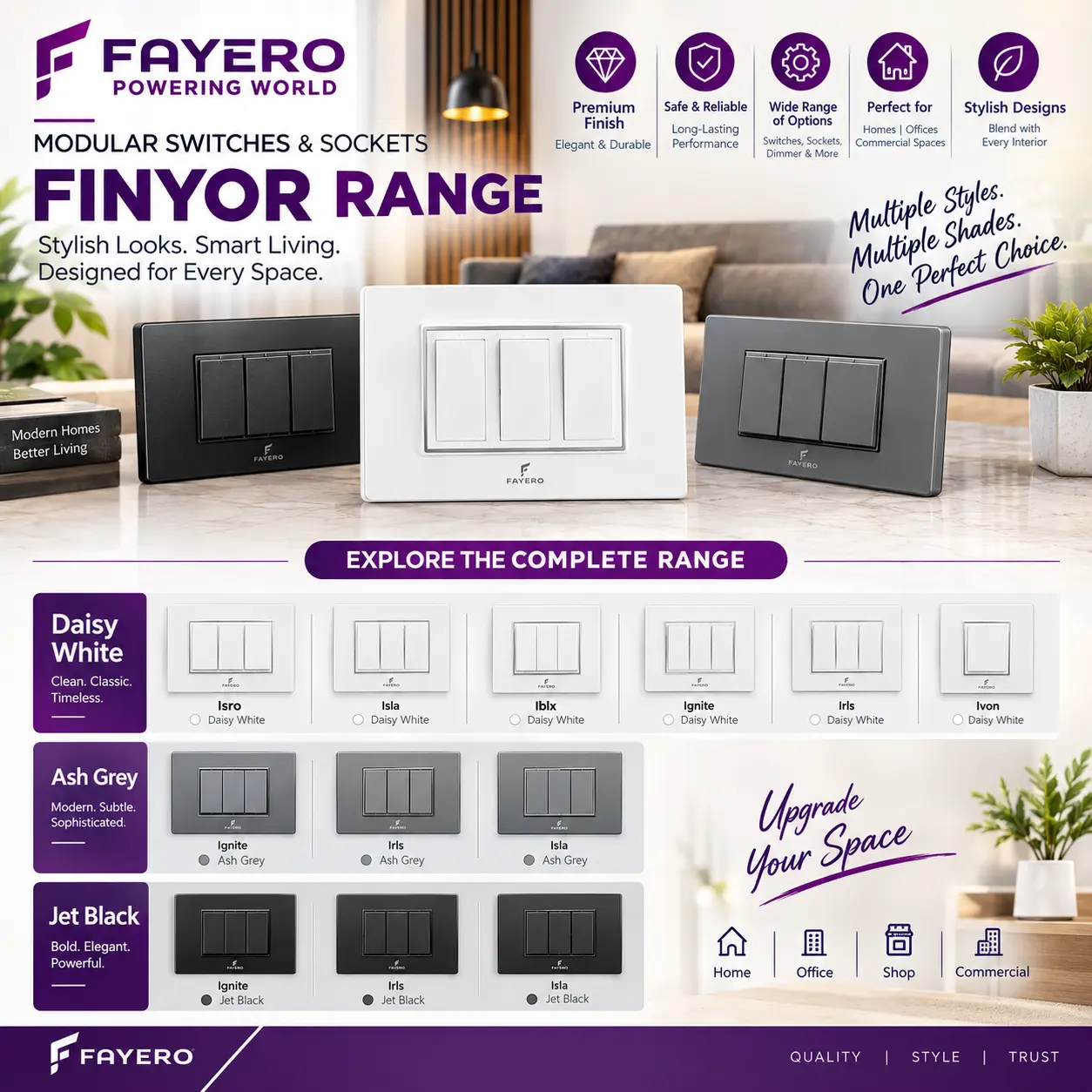
Look at the wall of any modern Indian home and you will see neat, flat plates with switches, sockets and sometimes a USB port, all sitting together in one clean panel. This is the modular system, and it has largely replaced the bulky old-style switchboards that had fixed, non-changeable parts.
Modular switches and sockets let you build a switchboard the way you want it, mixing and matching individual units on a single plate. This guide explains what they are, the main types, the common sizes and ratings, and how to choose the right combination for every room.
A modular switchboard is made of small, standardised units called modules. Each module does one job: a switch controls a light, a socket powers an appliance, a dimmer adjusts brightness, and so on. These modules snap into a common frame and are covered by a decorative plate.
The big advantage is flexibility. If you need an extra socket or a USB charging point later, you can replace one module without rewiring the whole board. Modular electrical switches also look cleaner, are safer because wiring is concealed, and are easier to maintain than the older surface-mounted types.
A typical modular setup has four parts:
Modules: the switches, sockets and other functional units.
Mounting frame (grid): holds the modules together in a fixed layout.
Cover plate: the visible front panel that gives a finished look.
Wall box (GI or PVC box): the concealed box embedded in the wall that holds everything.
Understanding these parts helps with switchboard module compatibility, because the frame, plate and wall box must match in size.
There are several Modular switch types, each designed for a specific purpose.
The most common type. It turns a light or fan on and off from a single location. It is used in almost every room.
This lets you control the same light from two different places, such as both ends of a corridor or at the bedroom door and bedside. It is wired in pairs.
Used along with two-way switches when a light needs control from three or more points, such as a long staircase or hall.
A spring-loaded switch designed for doorbells. It returns to its off position when released.
A dimmer controls the brightness of compatible lights, while a fan regulator controls fan speed. Modern regulators are compact and silent compared with old resistive types.
Includes a small light that glows when the switch is on or off. It is useful for geysers, ACs and other appliances you might forget to switch off.
Rated for higher loads, typically 20A or 32A, and used for geysers, air conditioners and large appliances. Many are double pole for complete isolation.
Choosing the right Modular Sockets is just as important as choosing the right switch, since using the wrong socket can lead to loose contact, overheating and short circuits.
The 5A socket is the standard for small appliances such as table lamps, chargers, televisions, set-top boxes and music systems. It accepts two-pin and three-pin 5A plugs.
A 6A socket, often seen in modular ranges as a 5/6A socket, handles light loads and is widely used for general household use. Many brands combine the 5A and 6A function in a single universal socket module.
A 16A power socket is designed for heavy appliances such as refrigerators, microwaves, washing machines, geysers and air conditioners. The pins are larger and thicker than a 5A plug and cannot be interchanged. Always pair it with a 16A or 20A MCB and 2.5 sq mm wire.
A universal socket accepts different types of plugs, including two-pin, three-pin, round and flat pin formats. It is especially useful for homes with imported appliances, for guests, or for travel chargers.
A USB charging socket has built-in USB ports, so you can charge phones and tablets directly without an adapter. Look for models with proper overcurrent protection and a rated output that suits modern devices.
These include TV and telephone sockets, data (LAN) sockets, and shaver sockets for bathrooms. They are useful for building a fully organised, future-ready switchboard.
Modular switch sizes are measured in modules, and a standard module is roughly the width of one switch. Switchboard plates come in several sizes based on how many modules they hold:
Some larger loads, such as a 16A socket, may occupy two modules, so check each product's module width before ordering. Plates and wall boxes follow standard dimensions, such as the common 3x3 inch (75 x 75 mm) and 3x6 inch (75 x 150 mm) sizes, but dimensions can vary by brand.
A well-planned switch socket combination makes a switchboard convenient to use every day. Here are practical modular switch and socket combinations for typical rooms:
2 light switches, 1 fan regulator
1 or 2 five-amp sockets near the bed
1 USB charging socket for phones
Optional: AC switch with indicator and a 16A socket
3 to 4 light switches, 1 fan regulator
2 five-amp sockets for TV and set-top box
1 universal socket
1 TV socket and a data socket for broadband
1 light switch and 1 exhaust fan switch
16A power sockets for fridge, microwave and mixer
20A heavy-duty switch for the chimney or geyser if required
Place sockets above counter height and away from water
Waterproof switch and light switch outside or protected with covers
Geyser switch with indicator
Shaver socket if needed, installed as per safety guidelines
Planning the layout before wiring begins saves you from adding extension boards later, which are a common cause of overload and fire.
Follow these steps when selecting products for your home:
Match the rating to the load. Use 5A or 6A for small appliances and 16A for heavy ones. Never plug a heavy appliance into a light-duty socket.
Check certifications. Choose products that carry the ISI mark and meet Indian electrical safety standards.
Look at contact quality. Good sockets use brass or copper alloy contacts with firm grip. Poor contact leads to sparking and heat.
Prefer shuttered sockets. Safety shutters block access to live parts, which protects children.
Pick flame-retardant materials. Quality polycarbonate or similar plastics resist heat and yellowing over time.
Confirm switchboard module compatibility. Make sure modules, frames and plates fit the wall boxes and come from the same series.
Choose a finish you will enjoy for years. White is timeless, while metallic and glass finishes suit premium interiors.
Check warranty and support. A reliable brand backs its product with a clear warranty.
Mixing modules from different series. They may not fit properly or may look uneven.
Using 5A sockets for heavy appliances. This causes overheating and possible fire.
Skipping wall boxes of the right depth. Shallow boxes make wiring difficult and can leave loose connections.
Ignoring future needs. Add extra sockets and USB points while the walls are open.
Choosing the cheapest option. Low-quality products wear out faster and can be unsafe.
Poor protection upstream. Even the best socket is only safe when the circuit is protected by the right MCB and an RCCB.
Modular switches and sockets last for many years with a little care:
Wipe plates with a dry or slightly damp cloth, never while the power is on.
Replace any switch that feels loose, hot or makes crackling sounds.
Do not force plugs into sockets or pull cords to remove them.
Have a licensed electrician inspect the switchboards periodically.
Modular switches and sockets bring together safety, convenience and good looks. Once you understand the main modular switch types, the difference between 5A, 6A and 16A sockets, and how to plan combinations for each room, choosing the right setup becomes simple. Always match ratings to loads, check certifications and buy from a trusted brand.
If you are planning a new home or upgrading your switchboards, Fayero is a name worth considering. Fayero offers modular switches and sockets designed for Indian homes, with a range that covers everyday switches, 5A and 16A sockets and USB charging options. Ask your electrician about Fayero modular ranges, plan your layout room by room, and build a switchboard that looks good and works safely. With Fayero, you can bring style, safety and reliability to every wall in your home