
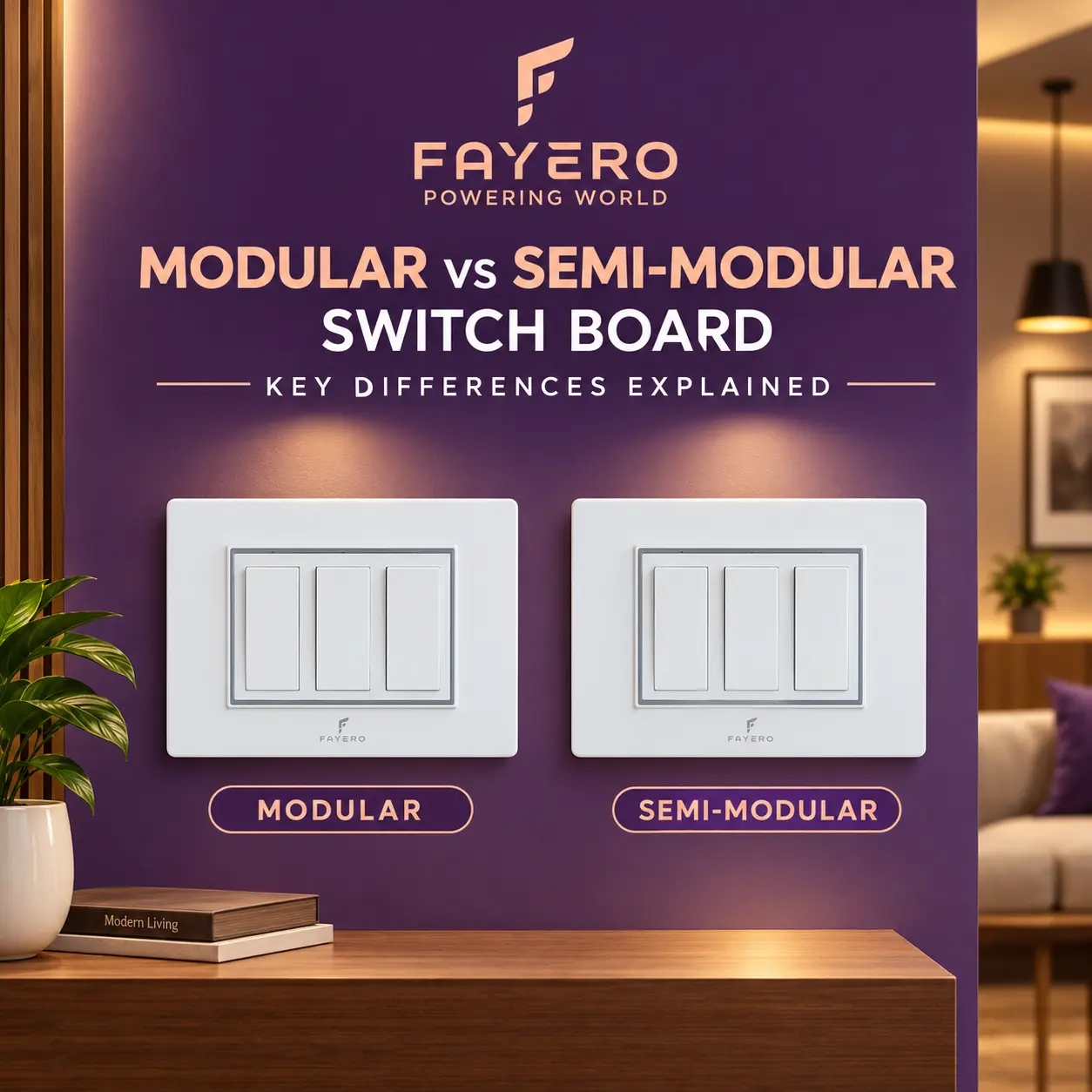
When you plan wiring for a new home or renovate an old one, one decision comes up early: should you go for a modular or a semi-modular switch board? Both look similar from a distance, and dealers often use the terms loosely, which leaves many buyers confused.
This guide explains the difference between modular and semi-modular switches in plain language, compares them on design, cost, installation and maintenance, and helps you decide which one suits your home.
A modular switch board is built from individual, standardised units called modules. Each module is a separate switch, socket, dimmer or regulator that clicks into a common frame, which is then covered by a decorative plate and fixed over a concealed wall box.
Because every function is its own module, you can add, remove or replace a single unit without changing the whole board. This flexibility, along with a clean flat finish, is why a modular switch board is the first choice in most modern homes.
A semi-modular switch board is a middle option between old-style fixed switches and fully modular systems. In this design, the switch mechanisms are usually fixed or built into a base unit, while the front cover plate can be removed or changed. You get some visual flexibility, but you cannot freely rearrange or swap individual functions the way you can in a modular system.
Semi-modular boards are usually lower in cost and are common in budget housing, rental properties and utility spaces where a basic, dependable setup is enough.
The simplest way to remember it is this:
Modular: every switch and socket is an independent module that can be mixed, matched and replaced individually.
Semi-modular: the working parts are partly fixed, so you can change the plate but have limited freedom to change the internal units.
Everything else, including price, look, installation and maintenance, follows from this single difference.
A modular switchboard design offers the widest choice of looks. Plates come in white, metallic, glass and wood finishes, and you can group switches and sockets in whatever layout suits the room. Slim profiles, soft-touch buttons and matching series across the home give a premium, coordinated feel.
Semi-modular boards have fewer designs. The plate may be removable, but the overall style is simpler and the options for colour and finish are limited. They look neat enough for functional spaces but rarely match the polished look of a modular range.
Flexibility is where the modular system wins clearly. With electrical switch modules you can:
Combine 5A sockets, 16A sockets, USB charging points, dimmers and indicators on one plate.
Add a new function later by swapping a blank module.
Rearrange a board during a renovation without opening up the wall.
A semi-modular board offers none of this freedom. What you install on day one is mostly what you keep.
Both types need a wall box, correct wiring and a competent electrician, but the process differs slightly.
Modular: the concealed wall box is fixed first, wires are brought in, modules are clipped onto the frame, and the plate is fitted over them. It takes careful planning of module counts and plate sizes, but gives a tidy, professional result.
Semi-modular: installation is usually simpler because there are fewer parts. The base unit is fixed in place and the plate is attached. It can be faster, which suits quick or low-budget jobs.
In both cases, always switch off the supply at the MCB before work begins, and use a licensed electrician for fitting and testing.
A semi-modular board almost always costs less at the time of purchase. A modular switch board costs more per point, but the extra investment often pays back over time through easier repairs, fewer full replacements and better long-term appearance.
If your budget is tight and the space is basic, semi-modular makes financial sense. If you plan to stay in the house for many years, modular usually offers better value.
Safety depends far more on product quality than on whether a board is modular or semi-modular. Whichever you choose, look for:
ISI-marked products that meet Indian electrical standards.
Flame-retardant plastic that resists heat and discolouration.
Brass or copper alloy contacts that grip plugs firmly.
Shuttered sockets that protect children from live parts.
Proper upstream protection with the right MCB and an RCCB.
Modular systems often have an edge here, because well-engineered modules are made to tighter tolerances and are built to hold connections firmly for years. Cheap versions of either type can loosen, heat up and spark over time.
Maintenance is much simpler with a modular system. If a switch fails, you replace that one module in a few minutes. If a plate gets stained or yellowed, you replace the plate alone.
With a semi-modular board, a faulty switch often means replacing the whole base unit, and sometimes the plate along with it. Over many years, the repeated cost and effort of switchboard replacement can cancel out the early savings.
A few maintenance habits help for both types:
Clean plates with a dry or lightly damp cloth, never with the power on.
Replace loose, hot or noisy switches at once.
Never force plugs into sockets or yank them out by the cord.
Get periodic inspections of your electrical system.
Switch plate compatibility is an important point that many buyers miss.
A modular switch plate must match the module series and frame it is designed for. Plates from different series or brands often do not fit.
A semi-modular switch plate is usually made for its own base unit and may not fit other designs.
Wall box sizes also vary, so confirm that the plate, frame and wall box dimensions match.
The safest approach is to buy the entire switchboard, including modules, frames and plates, from a single series. This avoids fit issues and keeps the finish consistent across rooms.
To sum up the main modular switchboard advantages:
Easy to customise and expand as your needs change.
Premium, clean look with many finish options.
Simple, low-cost repairs through module replacement.
Support for modern features such as USB charging, dimmers and indicator lights.
Better long-term value for homes you plan to live in for years.
Semi-modular boards are not a bad choice, just a different one. They work well when:
The budget is limited and the main goal is basic function.
The property is rented or temporary.
The space is a store room, garage, utility area or workshop.
You want a quick, straightforward installation without custom layouts.
Ask yourself these questions:
How long will I stay here? Long-term homes favour modular.
How much flexibility do I want? If you want USB points, dimmers and room to grow, choose modular.
What is my budget? Semi-modular saves money upfront.
Does the interior design matter? Modular gives a more refined look.
How easy should repairs be? Modular makes repairs quicker and cheaper.
For most family homes, the modular option is the better long-term choice, while semi-modular remains practical for budget or utility needs.
The debate of modular vs semi modular switch board comes down to flexibility, appearance and long-term value. Modular boards cost more at the start but give you easy upgrades, simple repairs and a cleaner look. Semi-modular boards keep costs down and suit simple, short-term needs. Whichever you choose, prioritise certified quality, matched components and safe installation.
If you want a dependable range to build your switchboards around, Fayero is worth a look. Fayero offers switch and socket solutions designed for Indian homes, helping you plan clean, safe and good-looking switchboards in every room. Speak to your electrician about Fayero, compare it against the checklist in this guide, and choose a setup that fits your budget and your style. With Fayero, upgrading your home's switchboards can be simple, safe and built to last.