
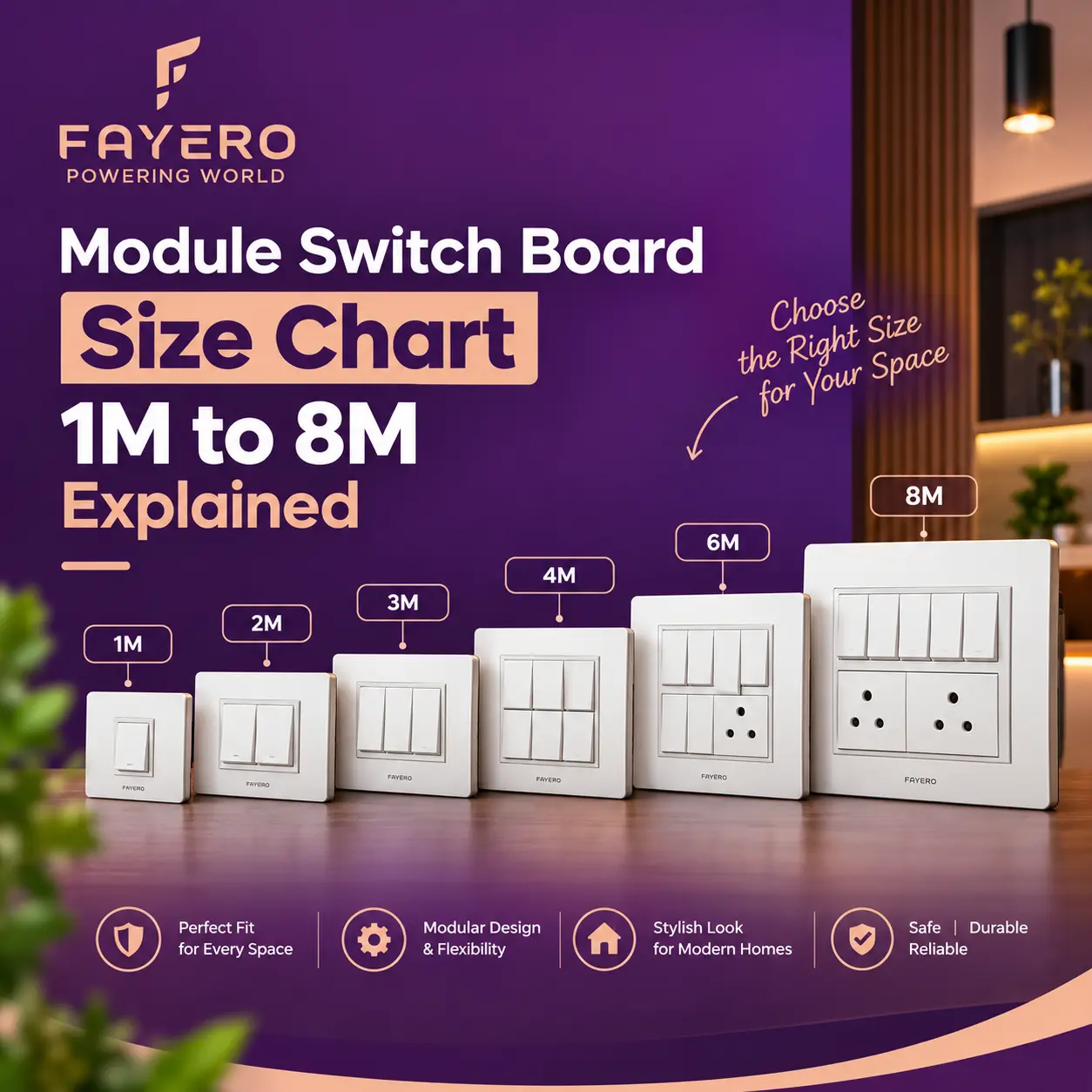
Anyone who has bought switches for a new home has heard terms like “2M plate”, “4 module board” or “8M box”. Dealers use them casually, and it is easy to nod along without knowing what they mean. A wrong guess leads to a plate that does not fit the wall box, or a board with no space for the sockets you need.
This guide is a complete module switch board size chart. It explains what a module is, how many modules fit on each plate, typical dimensions, and which size suits which room.
In a modular switchboard, a “module” is a standard unit of space. One module is roughly the space taken by a single basic switch. Switches, sockets, dimmers, fan regulators and USB chargers are all built in module widths, so they snap into a common frame behind the cover plate.
The number in front of the “M” tells you how many modules the plate can hold. A 4M plate holds four modules. Some products take more than one module of space. A 16A socket, for example, commonly takes two modules, while a standard 6A switch takes one.
This is why the answer to “how many modules in a switch board” depends on the plate you choose. Plates are sold in set sizes, and the module count is simply the plate’s capacity.
The chart below shows the common plate sizes in the Indian market, their capacity and typical use.
Most brands also offer 8M in both horizontal and vertical layouts, along with 12M, 16M and 18M plates for large boards.
Dimensions vary by brand and series, so treat these numbers as a guide and always check the product specification. As an indicative example, many ranges have plates with a height of around 93 mm and widths that grow with the module count:
The wall box behind the plate is smaller than the plate itself. A common 1M or 2M metal box measures roughly 75 x 79 mm (the familiar 3 x 3 inch size) with a depth of around 45 mm. Larger plates need correspondingly larger boxes.
The golden rule: the box must match the plate’s module count. A 6M plate needs a 6M box, and an 8M plate needs an 8M box. A mismatch leaves gaps, loose fittings or a plate that will not sit flush.
A 1 module switch board is the smallest option. The 1M switch module is a single unit, used for one function only: a light switch, a bell push, a fan regulator or a single socket.
You will see 1M plates in places that need just one control, such as a store room light, a corridor point or a dedicated regulator. Because it is so small, it is not suited to rooms where you want to group several functions.
People often ask what a 2 module switch board is. A 2M switch plate holds two modules, so it typically carries one switch and one socket, or two switches. It is the most common size for simple points, such as a bedside light with a charging socket.
One point to note: a 2M plate can also hold a single double-width item, such as a 16A power socket, which takes up both modules. Many brands use the same plate size for 1M and 2M and simply change the cutout, so they can look identical from the front.
A 3 module switch plate is a compact middle option. It suits bathrooms, small utility rooms and balconies, where you may need a light switch, an exhaust fan switch and one socket. It gives a little more room than a 2M plate without a big wall footprint.
A 4 module switch board is one of the most used sizes in homes. The 4M modular plate has room for four single modules, so a typical bedroom layout might use two light switches, one fan regulator and one socket.
For small bedrooms and study rooms, 4M is usually enough. For bigger rooms, where you also want a USB point or an AC switch, you will quickly outgrow it.
A 6M switchboard offers a comfortable balance of space and size, and is a popular choice for bedrooms and living areas. A sensible 6M layout is:
2 light switches
1 fan regulator
1 five-amp socket
1 USB charging socket
1 spare or blank module for future needs
Planning one spare module is a good habit. It keeps your options open when your needs change.
An 8 module switch board is the usual pick for living rooms, master bedrooms and kitchens. The 8M switch plate can carry a full set of controls: several lights, fan regulators, two or three sockets, a USB point and an AC switch.
Remember that heavy items such as 16A sockets take two modules each. Count their space before choosing the plate, not after.
Good switchboard layout planning matches the plate size to how the room is used. Here are practical modular plate combinations:
These are starting points. Counts will vary with the size of the room and the appliances you plan to use.
Follow these steps before you finalise plate sizes:
List every control and socket the point needs, room by room.
Count the modules each item takes, remembering that 16A sockets and some USB units use two.
Add one spare module for future use.
Choose the next plate size up that covers the total.
Check wall space and furniture. A wide 8M plate behind a headboard or beside a door frame must fit the available space.
Match the box to the plate size and wall type.
Use one series throughout. Plates, frames and modules from the same range fit together properly and look consistent.
Buying the plate first and counting modules later. Always count first.
Mixing a plate from one brand with a box from another. Dimensions often differ slightly, which causes poor fit.
Ignoring double-width modules. A 4M plate can run out of room faster than you expect.
Choosing the smallest plate to save money. Replacing a board later costs more than a slightly larger plate now.
Forgetting depth. Crowded boxes with thick wires and large modules need adequate depth for safe wiring.
Using light-duty sockets for heavy appliances. Use 16A sockets on suitable circuits, protected by the right MCB.
A neat layout is useful only if the products are safe. When you buy modules and plates, look for:
ISI-marked products that meet Indian safety standards.
Flame-retardant plastic that resists heat and yellowing.
Firm brass or copper alloy contacts that hold plugs tightly.
Shuttered sockets that protect children from live parts.
Clear markings for rating and manufacturer details.
Always have a licensed electrician install the board, and make sure the circuit is protected by the correct MCB and an RCCB.
Once you understand modules, a switch board size chart is easy to read. A 1M or 2M plate suits single points, 3M and 4M handle small rooms, 6M fits most bedrooms, and 8M and above serve busy living rooms and kitchens. Count modules before you buy, leave a spare, and always match the plate, frame and box.
If you are planning switchboards for a new home or a renovation, Fayero can help you build a clean, well-organised layout. Fayero offers modular switches, sockets and plates for Indian homes, so you can plan each room with matching components. Ask your electrician to work out your module count room by room, then compare Fayero plate sizes and finishes against your plan. With Fayero, choosing the right module size is simple, and your switchboards stay neat, safe and ready for future upgrades.
1. What is a module switch board size chart?
A module switch board size chart explains the capacity and approximate dimensions of modular switch plates, including 1M, 2M, 3M, 4M, 6M, and 8M sizes. It helps you choose the right switchboard for your room, sockets, and electrical controls.
2. How do I choose the right module switch board size for my home?
Choose a switchboard based on the number of switches, sockets, regulators, and other electrical controls required. A 4M board may suit a small bedroom, while a 6M or 8M board is often suitable for larger bedrooms and living rooms.
3. What is a 2 module switch board used for?
A 2 module switch board holds two modules and is suitable for simple electrical points. It can accommodate two standard switches or one switch and one compatible socket, depending on the module sizes and product design.
4. What is the difference between 4M, 6M, and 8M switch boards?
The main difference is their module capacity. A 4M switchboard holds four modules, a 6M board holds six, and an 8M board holds eight. Larger boards provide more space for multiple switches, sockets, regulators, and other electrical accessories.
5. Why is it important to match the switchboard plate with the wall box?
Matching the plate with the correct wall box helps ensure proper fitting, stable installation, and a neat finish. Always check the manufacturer's dimensions and compatibility specifications before installation, and use a qualified electrician for safe wiring.