
Choosing the right wire for your home is not simply about picking the thickest or most affordable option. The wire used in an electrical circuit needs to safely carry the amount of current that the connected appliances require. If the wire is too small for the load, it can heat up, lose energy and create a serious safety risk.
This is why understanding the wire gauge for home wiring is important before installing, extending or replacing any electrical circuit. The right wire size depends on several factors, including current load, circuit length, installation method, conductor material and the protection provided by the circuit breaker.
A proper electrical installation also requires the cable and protective device to be selected together. Electrical safety guidance emphasizes that cables should be correctly selected in relation to the fuse or circuit breaker protecting the circuit.
Wire gauge refers to the size or thickness of an electrical conductor. In systems that use AWG wire size, a smaller gauge number generally means a thicker wire. However, many countries, including India, commonly specify electrical wire using the conductor's cross sectional area in square millimetres rather than only AWG.
The cross section of a wire affects how much current it can carry safely. A thicker conductor generally has lower resistance and can carry more current than a thinner conductor of the same material and under comparable installation conditions.
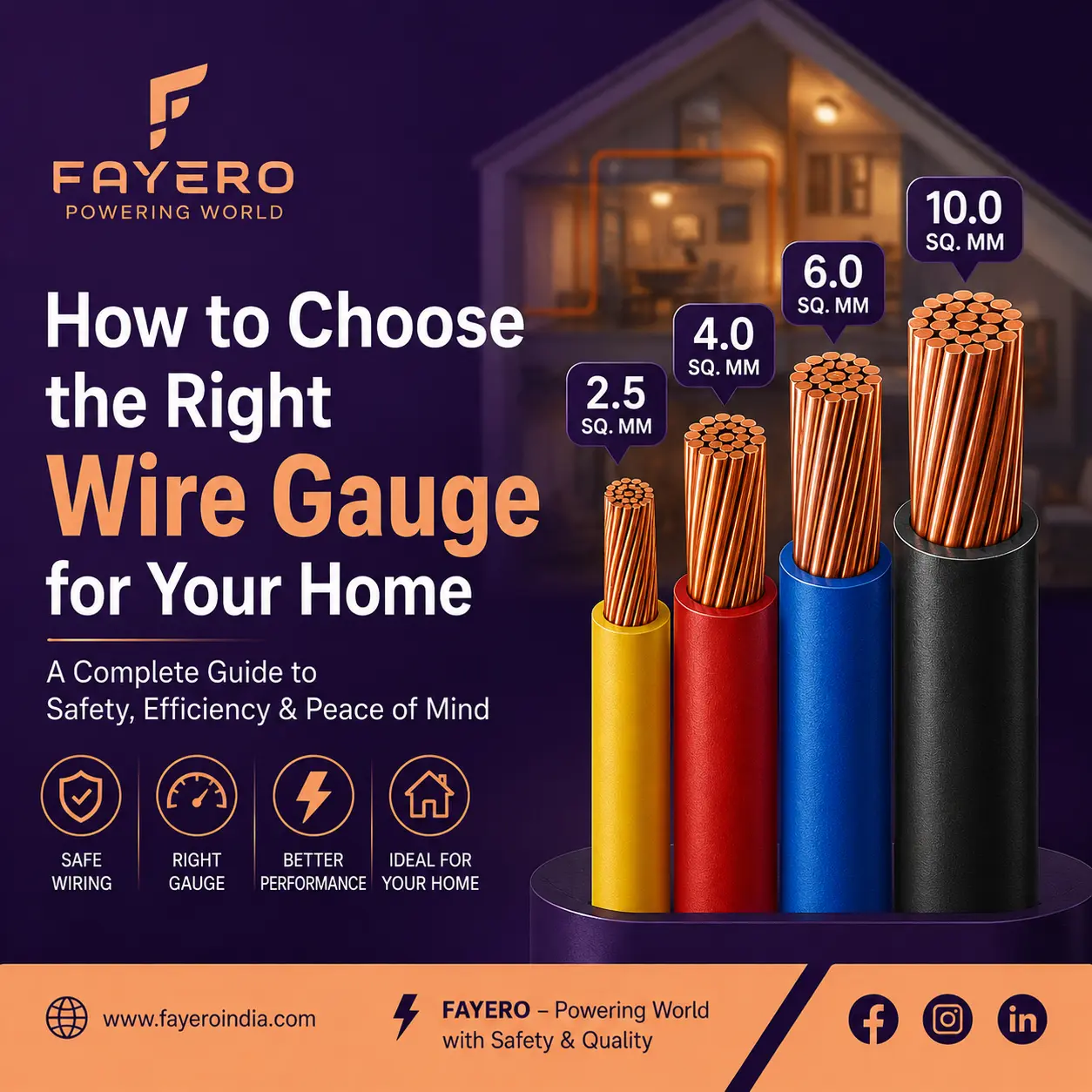
For home wiring, you may come across terms such as 1.5 mm², 2.5 mm², 4 mm² and 6 mm². These are examples of conductor cross sectional areas. The correct choice should be based on the circuit and its expected load rather than simply choosing a larger size.
Using the correct wire gauge is mainly about safety and reliable performance.
When a circuit carries more current than the conductor is designed to handle, the wire can become excessively hot. Continued overheating can damage insulation and electrical connections and may increase the risk of fire. Overloaded circuits can also cause frequent breaker trips, flickering lights, warm outlets and other warning signs.
On the other hand, using an unnecessarily large wire is not always the best solution either. It can increase material cost and may make installation more difficult. The goal is to select a conductor that is suitable for the expected load and installation conditions while meeting applicable electrical standards.
The first step in selecting the wire gauge for home wiring is understanding the electrical load.
Electrical appliances are normally rated in watts. To estimate current, you can use the basic relationship between power, voltage and current:
Current = Power ÷ Voltage
For example, a 1000 watt appliance connected to a 230 volt supply would draw approximately 4.35 amps under simple conditions.
If several appliances operate on the same circuit, their loads need to be considered together. A circuit supplying only lighting will have different requirements from a circuit supplying a washing machine, water heater, air conditioner or other high power appliance.
It is important to remember that the actual design also depends on factors such as appliance characteristics, starting current, power factor and local electrical requirements. Therefore, a simple calculation should be treated as an initial estimate rather than the complete wiring design.
Different circuits in a home can have very different requirements.
Lighting circuits usually carry smaller loads compared with circuits serving heavy appliances. General purpose socket circuits may supply several appliances, so their expected load needs to be considered carefully.
Dedicated circuits are often appropriate for appliances with higher electrical demand. An air conditioner, electric water heater, induction cooking appliance or similar equipment may require its own circuit depending on its rating and the applicable installation requirements.
This is one reason there is no single correct wire gauge for every part of a house.
The following sizes are commonly encountered in residential electrical work:
1.5 mm²: Often associated with lighting and other relatively light circuits, subject to the design and local requirements.
2.5 mm²: Commonly used for general socket circuits and moderate loads, depending on the installation method and protective device.
4 mm²: Often considered for circuits carrying higher loads, where the design requires it.
6 mm² and above: Used for larger loads and certain supply or dedicated circuits when required by the electrical design.
These examples are not a universal sizing chart. The permissible current carrying capacity, or ampacity, can change according to conductor material, insulation, ambient temperature, grouping, installation method and other factors. The protective device must also be appropriately matched to the circuit.
For this reason, simply copying a wire size from another house is not a safe way to design a circuit.
The length of the circuit is another important factor.
As a wire becomes longer, its resistance increases. Higher resistance can result in voltage drop, particularly when a circuit carries a substantial current over a long distance. Electrical guidance also notes that resistance increases with wire length and decreases as the conductor becomes thicker.
For a small household circuit, the effect may be limited. However, longer runs to another floor, outdoor area, garage or separate building may require additional consideration.
This is why an electrical wire size guide should not be used without considering the actual installation. The same load may require a different design when the cable run is significantly longer.
The way a wire is installed affects its ability to dissipate heat.
A cable installed in open air may have different heat dissipation characteristics from one placed inside a conduit, trunking or an enclosed space. Several cables grouped together can also affect the operating temperature.
These factors influence the current carrying capacity of the conductor. In professional electrical design, the wire size is therefore selected after considering the installation conditions rather than looking at the conductor size alone.
If you are planning concealed wiring, renovation work or a new electrical circuit, it is best to have the installation assessed by a qualified electrician.
The conductor material also matters.
Copper is widely used in residential wiring because of its good conductivity and practical installation characteristics. Aluminium conductors can also be used in certain applications, but they require appropriate equipment, connections and installation practices.
The wire size should therefore never be selected without considering the conductor material. Two conductors made from different materials may not have the same electrical performance at the same physical size.
Wire size and circuit protection work together.
A circuit breaker or fuse is designed to protect the electrical circuit from excessive current. The conductor must be selected so that the circuit is appropriately protected under the relevant electrical rules.
Installing a larger circuit breaker simply because a breaker keeps tripping is not a safe solution. If the circuit is overloaded or the wiring is unsuitable, increasing the breaker rating can expose the wiring to excessive current.
Frequent breaker trips should instead be treated as a warning that the circuit needs to be investigated. Other warning signs include buzzing sounds, burning smells, damaged insulation, discoloured outlets and unusually warm switches or socket outlets.
Many homeowners assume that a thicker wire automatically means a safer installation. While conductor size is important, it is only one part of the electrical design.
A safe circuit also needs suitable insulation, correct connections, proper earthing, appropriate circuit protection and installation according to applicable standards.
The condition of existing wiring also matters. Older or damaged wiring can have deteriorated insulation, loose connections or other problems that cannot be solved simply by replacing one section of cable. Electrical safety organisations recommend professional inspection when warning signs such as overheating, damaged insulation, flickering lights or repeated breaker trips appear.
When selecting wire for a home circuit, consider these points:
Identify the appliances and their power ratings.
Estimate the expected current load.
Decide whether the circuit is for lighting, sockets or a dedicated appliance.
Consider the circuit length.
Check the installation method.
Consider conductor material and insulation.
Select the appropriate protective device.
Check voltage drop where applicable.
Follow the electrical standards and requirements applicable to your location.
Have the final installation checked by a qualified professional.
This approach is much safer than choosing a wire based only on appearance or price.
Choosing the right wire gauge for home wiring is an important part of creating a safe and dependable electrical system. The ideal wire size depends on the current load, circuit length, installation method, conductor material and protective device.
Rather than asking which wire is the thickest, the better question is which wire is properly sized for the specific circuit.
A properly designed electrical system helps reduce overheating, unnecessary voltage drop and electrical hazards while allowing appliances to operate reliably. If you are unsure about the AWG wire size, wire cross section, ampacity or circuit protection required for your home, consult a qualified electrician instead of making assumptions.
For dependable electrical wiring solutions and products, Fayero can be considered as a trusted brand for homeowners and electrical professionals looking for quality electrical products.
The right wire gauge depends on the load, circuit length, installation method and circuit protection. Common sizes include 1.5 mm², 2.5 mm², 4 mm² and 6 mm².
Check the appliance wattage and calculate the current using power divided by voltage. A qualified electrician can confirm the correct wire size.
Not always. The correct wire should match the circuit load and installation requirements.
It can overheat, cause voltage drop and create serious electrical safety risks.
Fayero offers quality electrical wiring solutions designed for reliable and safe performance in home applications.