
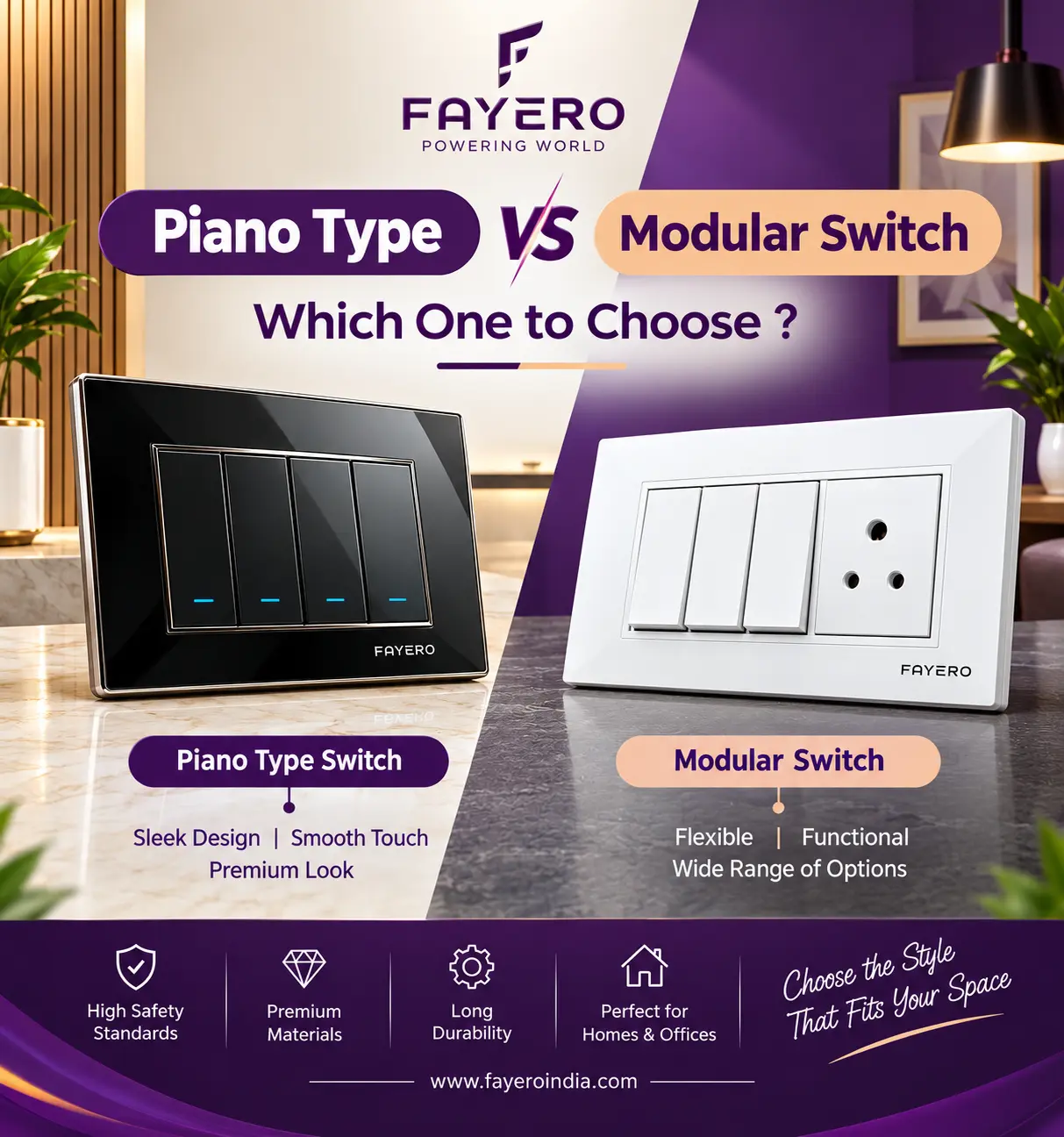
Stand in front of the switchboard in an older Indian home and you will probably see a row of wide, rectangular rocker keys, a bit like piano keys. Walk into a newly built apartment and you will see a slim, flat plate with small, neat switches and sockets. These are the two worlds of piano type switches and modular switches.
Both control the flow of electricity, but they differ in design, flexibility, appearance, cost and long-term value. This guide compares them in plain language so you can choose the right one for your home, budget and plans.
A piano type switch is a traditional switch with a wide, flat rocker key that is pressed down on one side to turn on and on the other to turn off. The shape and the click action resemble piano keys, which is how it got its name.
Piano switches are usually built as a fixed unit. The switch mechanisms, the base and the plate are assembled together, so you get a ready-made board of, say, four switches and a socket. You cannot easily rearrange the parts or add new functions later.
These switches have been used in Indian homes for decades and remain common in budget housing, rental flats, shops and utility areas.
A modular switch is built from individual units called modules. Each module is a switch, socket, dimmer, regulator or USB charger that clicks into a common frame. A decorative plate covers the frame, and the whole assembly sits on a concealed wall box.
Because each function is a separate module, you can mix and match, replace one module without disturbing the rest, and add new features such as USB charging points later. This flexibility, along with slim styling and many finishes, is why modular switches have become the standard in modern homes.
The piano switch design is functional and simple. The wide key is easy to find in the dark and easy to press even with a full hand, which is why many older people prefer it. But the look is dated: thick plates, limited colours and few finishes.
Modular switch design is much more varied. You can choose from white, black, metallic, glass and wood-finish plates, and from rocker, flat and touch-style keys. Slim plates sit flush with the wall and blend into modern interiors. Designers often treat the switchboard as part of the room’s styling, which is hard to do with piano switches.
The switchboard is one of the most noticed details on a wall. A piano board tends to look bulky and uniform, and it can age badly, with yellowing plastic and visible wear.
A modular board looks cleaner and more intentional. Matching plates across rooms give the home a coordinated look, and premium finishes can match your paint, tiles and furniture. If appearance matters to you, modular switches are the clear winner.
Both types use a spring-loaded contact mechanism that opens and closes the circuit, but the feel is different.
Piano switch operating mechanism: A large rocker key rocks on a central pivot. The action is firm and audible, and the broad surface makes operation easy.
Modular switch operating mechanism: Smaller keys or rockers sit on a precisely engineered mechanism, often with silver alloy contacts. Quality modular switches have a smooth, quiet, positive action and are tested for lakhs of operations.
Good build quality matters more than the type. A well-made piano switch can outlast a cheap modular one, but top-tier modular ranges are generally built to tighter tolerances.
Installation differs in how much planning it needs.
Piano switches: The board is fixed to a surface or flush box and wired directly. The process is quick and straightforward, which suits fast, low-cost jobs.
Modular switches: A concealed wall box is fitted first, wires are brought in, modules are clipped to the frame and the plate goes on top. You need to plan module counts and plate sizes, and the box depth must suit the modules. The result is tidier, but it takes more planning.
For both types, switch off the supply at the MCB before work starts and use a licensed electrician.
Repairs reveal the biggest practical difference.
With a modular board, if one switch fails you replace that single module in minutes. If a plate yellows or gets scratched, you change the plate alone.
With a piano board, a faulty switch often means replacing the entire unit, and sometimes the plate with it. Over many years, those repeated replacements can wipe out the early savings. Switchboard replacement in an older piano-type home also tends to mean a full change to modular when owners decide to upgrade.
Durability depends on materials, contact quality and brand. Look for:
Flame-retardant plastic that resists heat and yellowing.
Brass or copper alloy contacts that hold firmly and resist arcing.
Tested operating life, with ratings in the lakhs of operations.
Firm terminals that grip wires without loosening.
Well-made modular switches usually offer longer service life and better heat resistance, particularly in series with captive screws and silver alloy contacts. Cheap products of either type can loosen, heat and spark over time, which is a safety risk.
Piano switches for home use are still a practical choice in some situations:
Tight budgets where function matters more than looks.
Rental or temporary properties.
Store rooms, garages, workshops and utility areas.
Homes where elderly residents prefer large, easy keys.
Quick, simple repairs of existing old-style boards.
Modular switches for home use are the better fit when:
You are building or renovating and plan to stay for years.
Interior design and appearance matter.
You want USB charging, dimmers, indicators or smart controls.
You want easy upgrades and low-cost repairs.
You want a consistent look across every room.
For most families building a new house or renovating a flat, modular switches offer better long-term value, even though they cost more at the start.
A piano type switch is usually cheaper per point. A modular switch costs more at purchase because you are paying for the frame, plate and wall box on top of the switch itself.
Over time, the gap narrows. Modular boards need fewer full replacements, repairs are cheaper and the boards keep looking good for longer. If you are on a tight budget or the space is temporary, piano switches save money today. If you plan for the long term, modular usually costs less overall.
Safety depends on quality, correct installation and the protection behind the switchboard, not only on the switch type. For either choice:
Choose ISI-marked products that meet Indian standards.
Match socket ratings to appliance loads, with 16A sockets for heavy appliances.
Use shuttered sockets where children are present.
Protect circuits with the right MCB and an RCCB.
Replace any switch that feels hot, loose or noisy right away.
Modular systems often have a slight edge through better contacts, shutters and tighter build quality, but a good piano switch is safer than a poor modular one.
Ask yourself these questions:
How long will I stay here? Long term favours modular.
What is my budget? Tight budgets may favour piano.
How important is appearance? Modular wins on design.
Do I want USB points, dimmers or smart controls? Choose modular.
How easy should repairs be? Modular is simpler to maintain.
Is this a main living area or a utility space? Modular for living areas, piano for utility spaces.
A sensible hybrid also works: modular switches in bedrooms, living rooms and kitchens, and piano switches in store rooms, garages and servant quarters.
The choice between piano type switch vs modular switch comes down to budget, appearance and long-term plans. Piano switches are simple, affordable and easy to operate, which suits rentals and utility areas. Modular switches cost more at the start but reward you with better design, easy upgrades and cheaper repairs. Whichever you pick, prioritise certified quality, correct ratings and safe installation.
If you are planning new switchboards or upgrading old piano boards, Fayero can help you make the move to a cleaner, safer setup. Fayero offers switch and socket solutions for Indian homes, so you can plan every room with matching components and finishes. Talk to your electrician about Fayero, compare the options against the checklist above and choose the setup that suits your home. With Fayero, your switchboards can look modern, work reliably and stay ready for the future.
1. What is the difference between a piano type switch and a modular switch?
A piano type switch has a wide rocker key and a fixed design, making it simple and affordable. A modular switch consists of separate modules fitted into a frame, offering modern designs, greater flexibility, and easier repairs.
2. Which is better for home use: piano type switch or modular switch?
Modular switches are generally better for modern homes because they offer stylish designs, flexible configurations, easy upgrades, and convenient maintenance. Piano type switches are suitable for budget-conscious homes, rental properties, and utility areas.
3. Are modular switches more expensive than piano type switches?
Yes, modular switches usually have a higher initial cost because they require separate modules, a frame, a plate, and a suitable wall box. However, individual modules can be replaced when faulty, which may reduce long-term maintenance costs.
4. Are modular switches safer than piano type switches?
Safety depends on product quality, correct electrical ratings, and proper installation. Choose ISI-marked products that meet applicable Indian standards, and ensure the switchboard has suitable MCB and RCCB protection. A quality piano switch can be safer than a poorly made modular switch.
5. Can I replace piano type switches with modular switches?
Yes, piano type switches can be replaced with modular switches. The replacement may require a suitable wall box, wiring adjustments, and proper planning for module and plate sizes. Always hire a licensed electrician to ensure safe installation.