
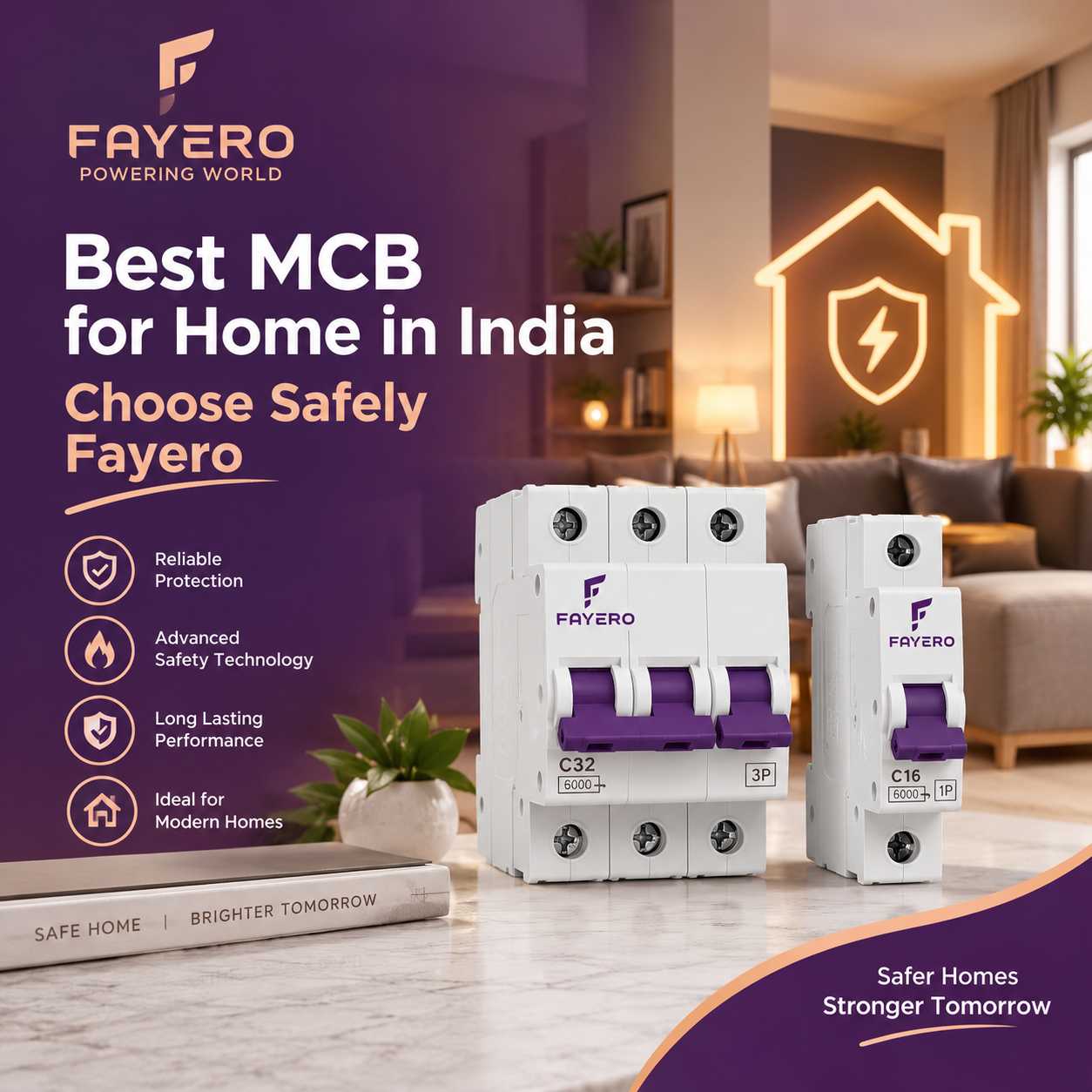
Every home in India runs on a quiet safety device that most people never think about until something trips: the MCB. Choosing the best MCB for home use is not about picking the most expensive box on the shelf. It is about matching the right rating to the right circuit and buying from a company you can trust. This guide covers what an MCB does, how to read MCB ratings, which MCB for home circuits suits which appliance, and which MCB company to buy from.
A miniature circuit breaker (MCB) is an automatic switch that cuts power when a circuit carries more current than it should. It protects against two main faults:
Overload: too many appliances running on one circuit for too long.
Short circuit: a sudden surge when live and neutral wires touch.
Older homes used rewirable fuses, which had to be replaced or re-wired after every fault. An MCB simply trips, and you switch it back on once the fault is fixed. It reacts faster and more reliably than a fuse and is far safer. Today, an MCB-based distribution board is the standard for any modern Indian home.
The rating printed on an MCB, such as 6A, 10A or 32A, is the maximum current it will carry continuously before it trips. Choosing the right MCB rating for home circuits comes down to one rule: the MCB must protect the wire, not just the appliance.
A rating too low trips again and again, even in normal use.
A rating too high lets the wire overheat before the MCB reacts. This is a real fire risk.
Always match the MCB to the wire gauge and the connected load, not to what is cheapest or what the electrician happens to have in stock.
Here is a practical MCB rating chart for typical Indian households with 230V single-phase supply:
Treat this as a guide. The final choice should always be confirmed by a licensed electrician who has checked your actual wiring and sanctioned load.
A 6A MCB for home lighting and fan circuits is the standard. Lights and ceiling fans draw very little current, so a 6A MCB gives tight protection on thin wiring. Most homes use one 6A MCB per room or per floor, so a fault in one area does not black out the whole house.
A 10A MCB for home use suits general 5A sockets that run chargers, televisions, desktop computers and similar devices. It is also a good fit for bedroom circuits where you plug in several small devices.
A 16A MCB for home circuits is the right call for a refrigerator, microwave oven, or a 1 ton AC on a dedicated line. It is also the usual choice for 15A power sockets. These loads draw high current for long periods, so a dedicated 16A circuit with 2.5 sq mm wire is far safer than sharing a general socket line.
A 20A MCB for home use is common for 1.5 ton ACs, storage geysers and washing machines. Because these appliances can draw a lot of current continuously, they should always run on their own circuit rather than sharing with sockets or lights.
A 32A MCB for home is typically used as a sub-main for a floor or kitchen, or as the main incomer in a house with a moderate sanctioned load. For larger homes with multiple ACs and electric appliances, higher ratings such as 40A or 63A may be needed at the main.
Another important choice is the number of poles.
Single pole MCB: This breaks only the live (phase) wire. It is widely used for individual circuits such as lights, fans and sockets, where the neutral stays connected.
Double pole MCB: This breaks both the live and neutral wires together. It gives better isolation and is the preferred choice for the main incomer, and also for geysers and ACs where full disconnection during maintenance matters.
A common and sensible home setup is a double pole MCB at the main (often paired with an RCCB or RCBO for earth-leakage protection) and single pole MCBs on individual circuits.
Along with the rating, the "curve" tells you how quickly the MCB reacts to a sudden surge:
B curve: trips at 3 to 5 times rated current. Best for pure household loads like lights and sockets.
C curve: trips at 5 to 10 times rated current. Better for appliances with motors or compressors, like ACs, fridges and pumps, which draw a high starting current.
D curve: trips at 10 to 20 times rated current. Mainly for industrial equipment, rarely needed at home.
For most Indian homes, B curve for lighting and general sockets and C curve for ACs and motor loads works well.
When you compare MCBs, look beyond the price tag:
Breaking capacity: Look for at least 10kA. This is the maximum fault current the MCB can safely interrupt, and it matters in dense urban supply networks.
Standards compliance: Choose MCBs that conform to IS/IEC 60898-1 and carry BIS certification.
Build quality: Flame-retardant housing, firm terminals and a smooth, positive switching action.
Clear markings: Rating, curve type, breaking capacity and manufacturer details should be clearly printed.
Terminal design: Good terminals hold wires tightly, which prevents loose-connection heating, a common cause of nuisance tripping and burnt boards.
Warranty and after-sales support: A reliable company stands behind its product.
Many buyers ask which MCB company to buy from, and the honest answer is that no single brand is right for every home. The best MCB brand for home use is one that checks these boxes:
Certified, tested products that meet Indian standards.
A complete range of ratings from 6A to 63A, so you can buy everything for the distribution board from one source.
Consistent quality across batches, not just in the showroom sample.
Easy availability through electrical dealers, so replacements are simple.
Responsive support and a clear warranty.
Avoid unbranded or unusually cheap MCBs. A faulty MCB that fails to trip is worse than having no MCB at all, because it gives you a false sense of safety.
Using one big MCB for the whole house. Split circuits so one fault does not shut everything down.
Putting a higher-rated MCB because of frequent tripping. Tripping is a warning. Find the cause instead of upgrading the breaker.
Sharing one circuit between a geyser and sockets. Heavy loads need dedicated lines.
Skipping earth-leakage protection. An MCB does not protect against electric shock. Add an RCCB or RCBO.
Ignoring wire size. An MCB is only as safe as the wire it protects.
List every circuit in your home and its load.
Pick the MCB rating using the chart above.
Choose single pole for individual circuits and double pole for the main.
Select B or C curve based on the load type.
Confirm 10kA breaking capacity and BIS certification.
Buy from a trusted, certified brand and have a licensed electrician install it.
Finding the best MCB for home in India is really about three things: the right rating for each circuit, the right pole and curve type, and a brand that delivers dependable quality. Get these right and your wiring, appliances and family stay protected for years.
If you want a dependable range to build your home's distribution board around, Fayero offers MCBs designed for Indian household needs, from 6A lighting circuits to 32A main protection. Whether you are wiring a new house or upgrading an old fuse box, Fayero makes it easier to match the right MCB rating to every circuit. Talk to your electrician, share the load details, and ask for Fayero MCBs so that your home is protected by a name focused on safety and reliability. For your next MCB purchase, choose Fayero and wire your home with confidence.
1. Which is the best MCB for home in India?
The best MCB for home in India is one that matches the circuit's electrical load, wire size, and safety requirements. Choose a certified MCB from a reliable brand, check its rating and breaking capacity, and consult a licensed electrician before installation.
2. Which MCB rating is suitable for home use?
The suitable MCB rating depends on the circuit and connected appliances. A 6A MCB is commonly used for lights and fans, 10A for small appliances, 16A for certain heavy appliances, 20A for some ACs and geysers, and 32A for sub-main or suitable main circuits. The final rating must match the wiring and actual load.
3. How do I choose the best MCB brand for home?
Choose an MCB brand that offers certified products, consistent build quality, clearly marked ratings, suitable breaking capacity, a reliable warranty, and accessible after-sales support. Avoid unbranded products and confirm that the MCB meets applicable safety standards.
4. What is the difference between a single pole and a double pole MCB?
A single pole MCB disconnects the live wire and is commonly used for individual household circuits. A double pole MCB disconnects both live and neutral together, providing greater isolation. The appropriate type depends on the circuit design and installation requirements.
5. What is the difference between B-curve and C-curve MCBs?
A B-curve MCB typically trips at 3–5 times its rated current and is commonly suitable for lighting and general socket circuits. A C-curve MCB typically trips at 5–10 times its rated current and may suit appliances with higher starting currents, such as ACs and refrigerators, when specified by an electrician.
6. Does an MCB protect against electric shock?
No. An MCB primarily protects electrical circuits against overloads and short circuits. It does not provide dedicated earth-leakage protection. An RCCB or RCBO can provide additional protection against earth-leakage faults when correctly selected and installed.
7. Why does an MCB trip frequently at home?
An MCB may trip frequently because of an overloaded circuit, a short circuit, faulty wiring, or an appliance problem. Do not replace it with a higher-rated MCB without identifying the cause. Ask a qualified electrician to inspect the circuit and confirm the correct rating.